Category archives: Theoretical physics

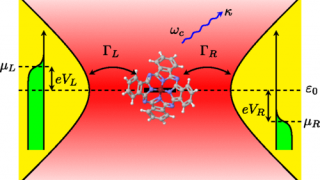
A local quantum emitter can be used to sense the environment of a molecule with the minimal quantum of energy

A local quantum emitter can be used to sense the environment of a molecule with the minimal quantum of energy

Condensed matterMaterialsNanotechnologyQuantum physicsTheoretical physics

By DIPC

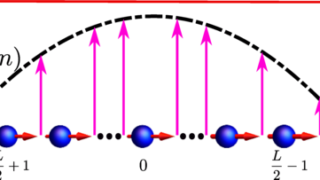
Plasmonic nanostructures confine light to dimensions far smaller than the free-space wavelength, as they mix optical fields with electronic excitations. It was not until the 1990s, with the appearance of accurate and reliable nanofabrication techniques, that plasmonics blossomed. It was found then that local fields around nanostructures could be directly measured by near-field scanning optical […]

A theory of spin hall magnetoresistance to study magnetism at interfaces

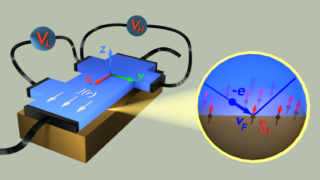
A theory of spin hall magnetoresistance to study magnetism at interfaces

Condensed matterMaterialsQuantum physicsTheoretical physics

By DIPC

The interactions between moving charges and magnetic fields can be quite complicated; more if we consider the quantum effects. One example is the collection of Hall effects. Imagine that we have a conductor or a semiconductor through which a current is flowing. Then we apply a strong transverse magnetic field. As a result, we can […]

The road to quantum gravity (4): The flow of time for massive objects

The road to quantum gravity (4): The flow of time for massive objects

CosmologyHistoryTheoretical physics

By Daniel Fernández

We started this series discussing the basic ingredients of the Universe: events, spacetime, causality. In the last chapter , we introduced massive objects (and thus, matter), which appear as a generalization of the so-called photon box. As it moves, any object traces a path. Physicists call it worldline . We established that a massive object […]

The road to quantum gravity (3): The speed of light and the origin of mass

The road to quantum gravity (3): The speed of light and the origin of mass

CosmologyHistoryTheoretical physics

By Daniel Fernández

In the previous chapter of this series, we went over the subjective, relative separation of the network of events known as Spacetime into space and time. The speed of light played a major role in the discussion. In particular, we divided Spacetime into three regions (with respect to a particular event) defined by the existence […]

An efficient tensor network algorithm for capturing thermal states of 2D quantum lattice systems

An efficient tensor network algorithm for capturing thermal states of 2D quantum lattice systems

Condensed matterQuantum physicsTheoretical physics

By DIPC

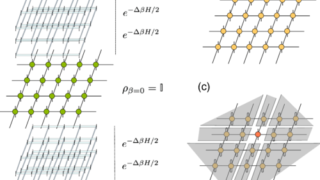
The concept of vector should be familiar: a quantity for which both magnitude and direction must be stated. This compares with a scalar quantity, where direction is not applicable, like temperature in a precise point. But, what if the magnitude varies with the direction? A vector would be a particular case, with only one direction […]

A Talbot carpet of electrons in nanoporous graphene

A Talbot carpet of electrons in nanoporous graphene

Condensed matterMaterialsNanotechnologyQuantum physicsTheoretical physics

By DIPC

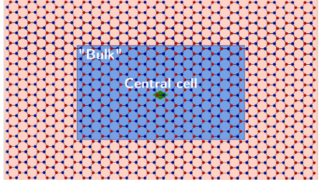
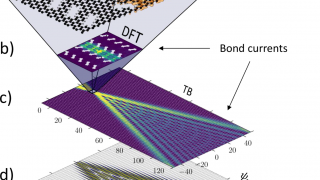
Controlling electron waves by harnessing phase-coherence and interference effects is a cornerstone for future nanoelectronics or quantum computing. To this end, design of platforms with well-defined, narrow, and low-loss propagation channels is essential. Nanoporous graphene (NPG) holds great potential for distributing and controlling currents on the nanoscale. But the effects derived from the wave nature […]