Search results: spintronics

Mechanochemistry of nanographenes

Mechanochemistry of nanographenes

ChemistryCondensed matterMaterialsNanotechnology

By DIPC

Modern organic industrial chemistry started when William Henry Perkin serendipitously synthesized mauveine in 1856 while he was attempting the total synthesis of quinine. Since then, thousands of new organic products have been created in the laboratory for industrial purposes. Among them, in 1913, an orange-red pigment was found, first known as Vat Orange 3 dye […]
Unexpected molecular core level shifts in nanoarchitectures

Unexpected molecular core level shifts in nanoarchitectures

ChemistryCondensed matterMaterialsNanotechnology

By DIPC

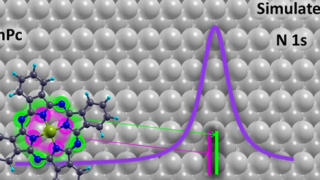
Mimicking natural processes has been a recurrent strategy for the development of new technologies, from velcro to bullet trains. Thanks to the advances in scientific knowledge and technological tools achieved over the last decades, biologically inspired research has evolved from the macroscale to the nanoscale. This poses an interdisciplinary challenge, involving fields such as molecular […]

Towards a bottom-up engineering of molecular spintronic devices

Towards a bottom-up engineering of molecular spintronic devices

ChemistryCondensed matterNanotechnology

By DIPC

During the last decades, the electronics industry has been very successful in pushing forward the advancement of electronic building blocks, but the limit of silicon-based electronic devices especially in terms of miniaturization are almost reached. There are many ideas how to overcome this problem, for example, by adding functionality based on approaches originating from molecular […]

Tuning graphene adsorption continuously

Tuning graphene adsorption continuously

Condensed matterMaterialsNanotechnologyPhysics

By DIPC

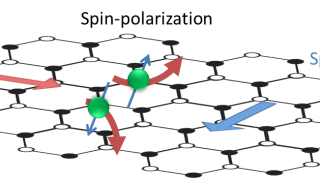
Since the discovery that graphene, the two dimensional carbon allotrope, can be isolated and incorporated into electronic devices intense research efforts have been triggered. Driving forces behind the experimental and theoretical studies of graphene are, e.g., the exceptional electronic properties, in particular the high electron mobilities, the long spin coherence lengths and the possibility to […]

How to study magnetic Weyl fermions experimentally

How to study magnetic Weyl fermions experimentally

ChemistryCondensed matterQuantum physicsTheoretical physics

By DIPC

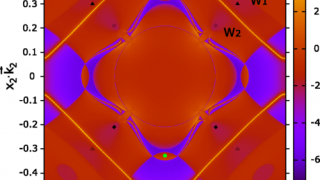
Imagine there exist a material in which an electron could be split into two quasiparticles. These two quasiparticles both would carry electric charge, move in opposite directions but could not move backwards. Furthermore these quasiparticles would be massless. And we can give them a fancy name, Weyl fermions. This seems to be at odds with […]

Manipulating the topological surface states with molecular adsorbates

Manipulating the topological surface states with molecular adsorbates

Condensed matterMaterials

By DIPC

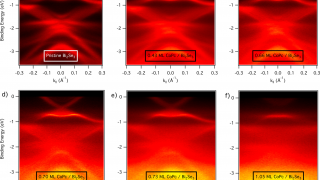
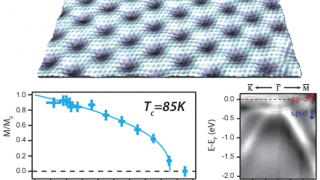
A topological insulator is a material in which there is order associated to topology, i.e., the surface can conduct electricity but the bulk of the material is an insulator. In these last years topological insulators have received the attention of a large area of the scientific community thanks to their exotic properties. They are promising […]

An ideal candidate to investigate nanoscale ferromagnets and exotic interfaces

An ideal candidate to investigate nanoscale ferromagnets and exotic interfaces

ChemistryCondensed matterPhysicsQuantum physics

By DIPC

In order to study new solid state magnetic properties appropiate new laboratory models are needed. In particular, there is a necessity for a substrate to investigate new forms of magnetic coupling with nanoscale ferromagnets and the exotic physics at the interface with semiconductor or superconductor materials. Now a team of researchers from DIPC and some […]

Impurities and spin Hall effects in graphene

Impurities and spin Hall effects in graphene

Condensed matterMaterialsPhysicsQuantum physics

By DIPC

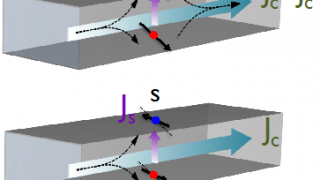
The interactions between moving charges and magnetic fields can be quite complicated; more if we consider the quantum effects. One example is the collection of Hall effects. There are analogues of these effects for spin and the detection of the most sophisticated one in graphene, where, at least, it should not be strong, is something […]