Chemical bonding as quantum entanglement
Chemical bonding as quantum entanglement
Chemical bonds are among the most familiar ideas in science. They explain why hydrogen and oxygen combine to form water, why carbon atoms build long chains in organic molecules, and why every substance has the shape and properties it does. Yet, despite their central role in chemistry, bonds are not directly observable objects. They are concepts, extraordinarily useful ones, invented to describe the behaviour of electrons. A new study 1 now proposes that the deepest explanation for chemical bonding may be found in a branch of modern physics known as quantum information theory.
The story of chemical bonding begins in 1916, when the American chemist Gilbert N. Lewis proposed that atoms are held together by pairs of shared electrons. Lewis developed this idea entirely without the benefit of quantum mechanics, which had not yet been formulated. His diagrams — now known as Lewis structures — are still taught in every introductory chemistry course and remain one of the most powerful tools for predicting molecular shape and reactivity. In 1927, the physicists Walter Heitler and Fritz London provided the first rigorous quantum mechanical account of a chemical bond, applying the newly developed Schrödinger equation to the hydrogen molecule. Their calculation showed that the stability of H2 arises from the quantum mechanical exchange of electrons between the two atoms, a phenomenon with no counterpart in classical physics. These two theoretical traditions, valence bond theory and molecular orbital theory, have shaped how chemists think about bonds ever since.
Despite this long history, a precise and universal definition of a chemical bond remains elusive. Modern quantum chemistry can compute molecular properties with remarkable accuracy, but the more sophisticated the calculation, the harder it becomes to extract a simple, intuitive picture of bonding. Various tools have been developed to address this gap, but they often rely on different assumptions and sometimes give conflicting answers. Bond order, hybridization, aromaticity, these concepts are taught as concrete realities, yet they are better understood as interpretive frameworks rather than directly measurable quantities.
Entanglement as the right language
The new study approaches this problem from an unexpected direction: quantum entanglement. In quantum mechanics, two particles are said to be entangled when their properties are correlated in such a way that neither can be fully described without reference to the other, regardless of how far apart they are. Entanglement was first discussed theoretically in 1935 by Einstein, Podolsky, and Rosen, who regarded it as a paradox. It is now central to quantum computing and quantum communication. The study argues that entanglement is also the right language for describing chemical bonds, precisely because a covalent bond is itself a nonlocal phenomenon: the electrons involved are shared between atoms and do not belong exclusively to either one.
Maximally entangled atomic orbitals
To translate this idea into a practical tool, the study introduces a new type of mathematical object called maximally entangled atomic orbitals, or MEAOs. Atomic orbitals are the quantum mechanical wave functions that describe where electrons are likely to be found around individual atoms. The key innovation is to choose the orbitals not to resemble free atoms as closely as possible, as most existing methods do, but instead to maximise the quantum entanglement between different atomic centres. The result is a set of orbitals specifically designed to make bonding interactions as visible and as quantifiable as possible.
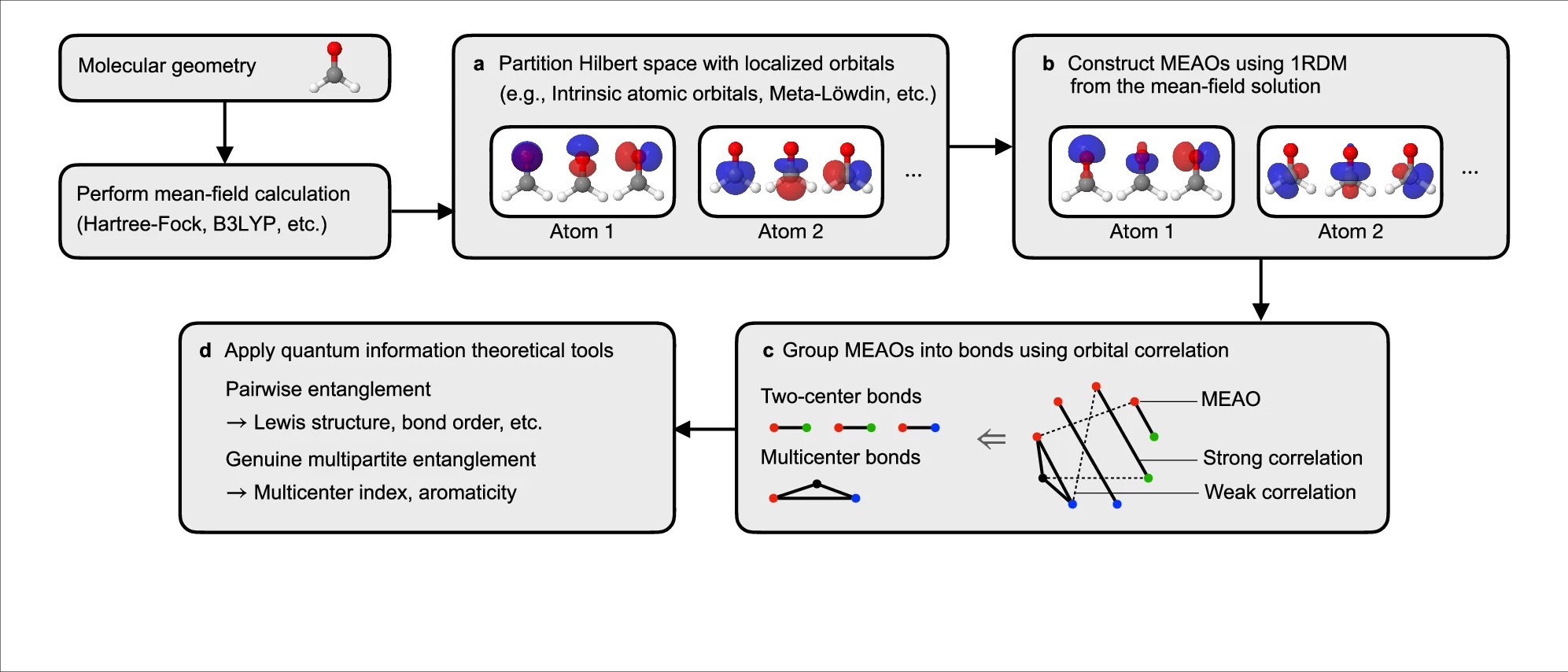
What happens when this approach is applied to real molecules is striking. In ethene (C2H4), for example, the MEAO analysis automatically identifies four carbon–hydrogen single bonds and two carbon–carbon bonds (one sigma bond and one pi bond) matching exactly the Lewis structure that any chemistry student would draw. Moreover, the carbon orbitals in the MEAO picture naturally adopt the shape of sp2 hybrid orbitals, a consequence of quantum mechanics rather than an assumption imposed from outside. Hybridization, the idea that atomic orbitals mix to form new orbitals better suited to bonding, is a rigorous result of quantum mechanics, but the particular hybrid form adopted by an atom depends on its molecular environment. The MEAO framework finds that form automatically, without being told what to look for.
The strength of each bond can then be measured by the amount of entanglement between the two orbitals that form it. Strong covalent bonds, such as those in nitrogen gas (N2) with its triple bond, show entanglement values close to the theoretical maximum. Moving from lithium dimer (Li2) through lithium hydride (LiH) to lithium fluoride (LiF), the entanglement decreases progressively, tracking the well-known shift from covalent to increasingly ionic bonding. When tested on helium dimer (a weakly bound van der Waals complex rather than a true chemical bond) the method correctly returns zero entanglement.
The test of the harpoon mechanism
One of the most demanding tests of any bonding analysis method is the dissociation of lithium hydride. At its equilibrium geometry, LiH is predominantly an ionic molecule: the lithium atom effectively donates an electron to the hydrogen atom, producing Li+ and H– ions. Yet some covalent character remains. As the bond is stretched, the molecule passes through what is known as an avoided crossing (a region where two electronic energy levels come very close together but do not intersect) and its character shifts from predominantly ionic to predominantly covalent. Beyond this point, as the atoms continue to separate, the bond ultimately breaks and the covalency decreases again. This transition, in which an electron appears to be “harpoon” back from the hydrogen, is called the harpoon mechanism and it produces a characteristic peak in bond covalency as a function of bond length. Detecting this peak is a recognised benchmark for bonding descriptors, and some orbital-based methods based on Hilbert space partitioning fail to reproduce it. The MEAO entanglement analysis detects it clearly, showing a peak in orbital entanglement that coincides with the avoided crossing.
Aromaticity and multicentre bonding
Many important molecules contain electrons shared among three or more atomic centres simultaneously. Such multicentre bonds cannot be captured by the two-orbital entanglement used for ordinary covalent bonds. For these cases, the study introduces a related quantity called genuine multipartite entanglement, which measures the degree to which a group of three or more orbitals is collectively and irreducibly entangled; that is, correlated in a way that cannot be reduced to a combination of pairwise correlations. Three-centre bonds in species such as the ethyl cation (C2H5+, an electron-deficient carbocation) and the allyl anion (C3H5–) are correctly identified and assigned high values of this multipartite entanglement measure.
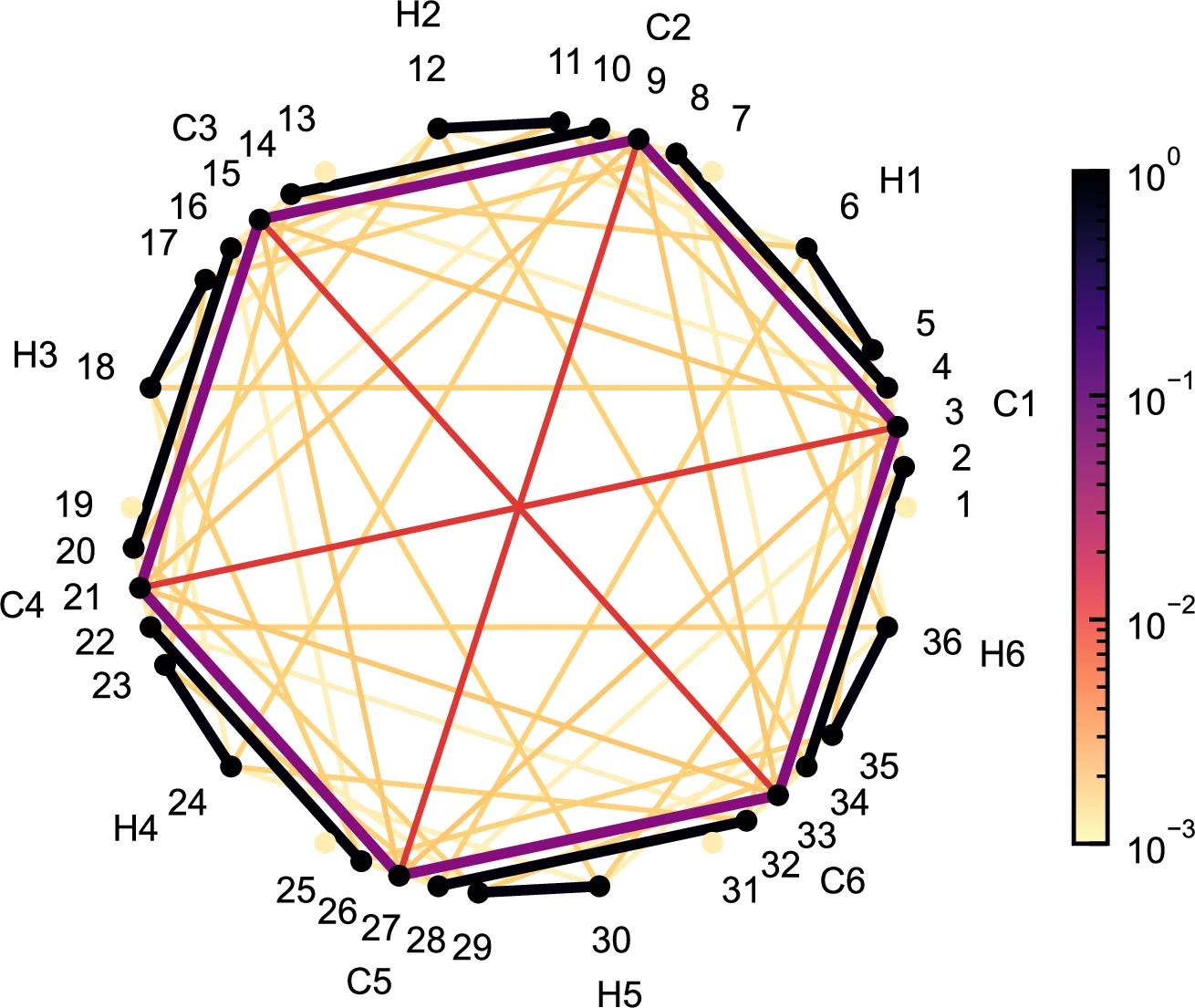
The most eye-catching application of multipartite entanglement in this work may very well be to aromaticity. Aromatic molecules are a special class of cyclic compounds, of which benzene (C6H6) is the archetype. In benzene, six electrons occupy six orbitals arranged in a ring above and below the plane of the molecule, and these electrons are not confined between any single pair of atoms but are delocalised around the entire ring. This delocalization gives aromatic compounds unusual stability and distinctive reactivity. The MEAO analysis identifies benzene’s six π orbitals as a single highly entangled cluster, assigning a multipartite entanglement value close to the theoretical maximum. In contrast, non-aromatic six-membered rings such as cyclohexane show values nearly a hundred times smaller. The method also correctly tracks the modest reduction in aromaticity when one or more of benzene’s carbon atoms is replaced by nitrogen, and the progressive decrease when the ring geometry is distorted from its equilibrium shape.
A particularly demanding test is provided by the Diels–Alder reaction, one of the most important bond-forming reactions in organic chemistry. First described by Otto Diels and Kurt Alder in 1928 (a work that earned them the Nobel Prize in 1950) the reaction involves a conjugated diene and a dienophile combining to form a six-membered ring. Neither the starting materials nor the final product is aromatic, but during the reaction the six π electrons involved pass through a transition state in which they are transiently delocalised around a forming ring, giving that fleeting arrangement a transient aromatic character. Several widely used aromaticity indices, including HOMA and FLU, fail to detect this transient aromaticity in the transition state. The multipartite entanglement measure shows a clear peak precisely where the transition state occurs, providing clean confirmation of this long-discussed but difficult-to-measure feature of the reaction.
The framework is also tested on chromium hexacarbonyl, Cr(CO)6, a prototypical transition-metal complex. Carbon monoxide on its own has a very strong triple bond between the carbon and oxygen atoms. When CO coordinates to a metal centre, the well-known Dewar–Chatt–Duncanson model predicts that this bond should weaken as electron density is redistributed between the ligand and the metal. The MEAO analysis of Cr(CO)6 correctly reproduces this weakening: the entanglement values for the C–O bond decrease relative to free CO, while new entanglement between the chromium centre and the carbon atoms appears, quantitatively consistent with the expected donation and back-donation of electron density.
Not a metaphor
The message is clear: chemical bonding can be understood as a manifestation of quantum entanglement. This is not merely a metaphor. The entanglement between atomic orbitals, when those orbitals are chosen to maximise it, turns out to encode quantitatively the bond orders, hybridization patterns, multicentre connections, and aromatic properties that chemists have been describing qualitatively for over a century. Concepts that have long been regarded as somewhat fuzzy or model-dependent emerge as precise, computable quantities from a single quantum mechanical principle.
This does not mean that Lewis structures or molecular orbital diagrams will disappear from chemistry textbooks. They remain powerful and intuitive. What the new framework offers is a rigorous foundation that unifies them: a way of asking, in the language of quantum information, exactly how deeply the parts of a molecule are connected to one another. In doing so, it draws together two fields, quantum chemistry and quantum information theory, that have until recently had surprisingly little overlap, and suggests that each has much to offer the other.
Author: César Tomé López is a science writer and the editor of Mapping Ignorance
Disclaimer: Parts of this article may have been copied verbatim or almost verbatim from the referenced research paper/s.
References
- Ding, L., Matito, E. & Schilling, C. (2026) Chemical bonding concepts emerge naturally from maximally entangled atomic orbitals. Nat Commun doi: 10.1038/s41467-026-73527-w ↩