Search results: van der waals

Rewriting the rules of heteroepitaxy with a flexible crystal

Rewriting the rules of heteroepitaxy with a flexible crystal

Condensed matterDIPC Advanced materialsMaterials

By DIPC

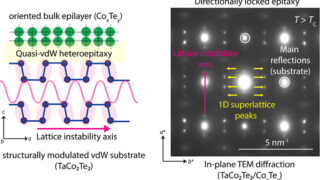
Building electronic devices often requires stacking different crystalline materials on top of one another with atomic precision. This process, called heteroepitaxy, works best when the two crystals share similar atomic patterns. When their symmetries differ, the upper crystal tends to grow in several orientations at once instead of a single one, creating defects that degrade […]
Chemical bonding as quantum entanglement

Chemical bonding as quantum entanglement

ChemistryDIPC Computational and Theoretical ChemistryQuantum chemistry

By DIPC

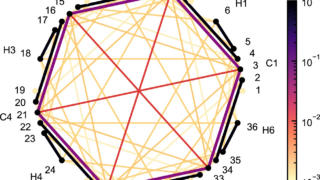
Chemical bonds are among the most familiar ideas in science. They explain why hydrogen and oxygen combine to form water, why carbon atoms build long chains in organic molecules, and why every substance has the shape and properties it does. Yet, despite their central role in chemistry, bonds are not directly observable objects. They are […]

Bending Ohm’s Law: How symmetry-broken crystals rewrite the rules of electronics

Bending Ohm’s Law: How symmetry-broken crystals rewrite the rules of electronics

Condensed matterMaterialsQuantum physics

By Invited Researcher

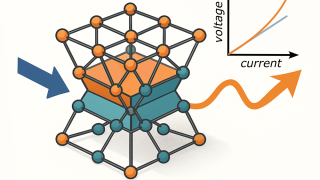
When Georg Ohm wired up pieces of copper in 1827, he struck a rule so robust that it still underpins every phone and supercomputer on Earth: double the current, double the voltage. Simple, linear, universal—or so we thought. Over the past decade physicists have discovered that this bedrock principle crumbles the moment a crystal loses […]

Triple-decker antiaromatic π-stacking leads to a liquid crystal

Triple-decker antiaromatic π-stacking leads to a liquid crystal

Chemistry

By César Tomé

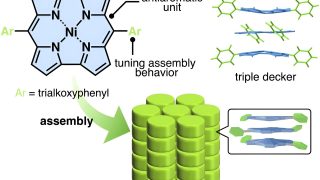
In organic chemistry, π-stacking systems are supramolecular structures that arise due to the dispersion force, a type of intermolecular noncovalent interaction. They are a common occurrence in nature. The stabilized structure of DNA is a very prominent example of a π-stacking system, and so are the arrangement of amino acids in certain proteins. Interestingly, π-stacking […]

Epitaxial films of a transition metal dihalide grown on gold

Epitaxial films of a transition metal dihalide grown on gold

DIPC Electronic PropertiesDIPC Interfaces

By DIPC

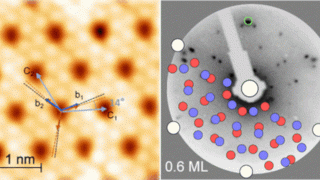
Magnetic two-dimensional (2D) semiconductors have attracted a lot of attention because modern preparation techniques are capable of providing single crystal films of these materials with precise control of thickness down to the single-layer limit. It opens up a way to study a rich variety of electronic and magnetic phenomena with promising routes towards potential applications […]

Engineering high Chern number materials

Engineering high Chern number materials

DIPC Advanced materialsMaterials

By DIPC

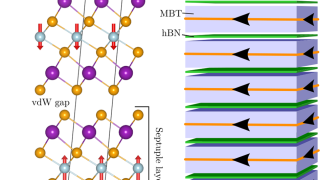
Some materials have special universal properties protected against perturbations. Such properties are theoretically described by topology, a branch of mathematics concerned with the properties of geometrical objects that are unchanged by continuous deformations. So-called topological insulators are electronic materials that have a bulk band gap like an ordinary insulator but have conducting states on their […]