The Enlightenment wars (& 3): but…what kind of humanism do we need?
The Enlightenment wars (& 3): but…what kind of humanism do we need?
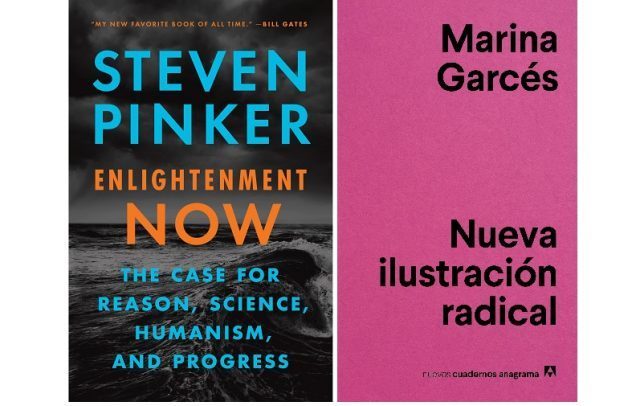
In the two previous entries (1, 2) of this series I described the different diagnoses that Marina Garcés and Steven Pinker make of humanity’s current predicament, without concealing my sympathies for the latter’s: with up and downs, with unequal division of the benefits, without bringing us a literal paradise, with lots of problems still to solve… the undeniable fact is that human progress has been (and is being) spectacular since ‘Modernity’ began its expansion. True, catastrophes like the two World Wars, the Holocaust or the Gulag inspired in many intellectuals a deep mistrust in the capacity of the values and institutions of the Enlightenment for delivering the promises contained in the writings of people like Diderot, Smith or Kant. The 1944 book Dialectic of the Enlightenment, by the Frankfurt Scholars Max Horkheimer and Theodor Adorno (two German Jews then exiled in California), is perhaps the best example of such skepticism. I think Marina Garcés’ book shares a lot of the old Frankfurtians’ mistrust in capitalism and liberal democracy as the ‘monstruous creatures’ of the Enlightenment, though perhaps not their ineradicable pessimism about the power of reason to lead humans to a society of freedom and emancipation. I don’t think to err too much if I say that, for Garcés, something that might be called liberalism would be the main culprit of having created the ‘posthumous condition’ we mentioned in the first entry out of the promises of Modernity. Pinker, in particular, would perhaps be for her the prototype of a ‘liberal intellectual’ (taking also into account the semantic difference between the European and the American meanings of ‘liberal’), if not something still worse: a positivist thinker, and hence an example of what Garcés’ demand for a ‘New Radical Enlightenment’ is opposing to. The Spanish philosopher, on her turn, would also be an example of what Pinker calls “left-wing progressophobs”, though perhaps not as dangerous as the right-wing ones, like Trump or the national-populist European parties.
In this last entry, I’m turning to more philosophical topics: besides the question about ‘who gets the facts right’ (which, I repeat, it’s difficult not to concede to Pinker that he is mostly right on that factual question), I think everyone will be curious about the deep motives of such huge differences between both points of view. On these I cannot offer but a fistful of conjectural arguments, of course, but that’s what all philosophy is about; isn’t it? One plausible conjecture, but one I think is not very accurate, would be that what mainly divides people like Pinker from people like Garcés is their degree of sympathy towards society’s ‘loosers’. It’s not, of course, that one is unconditionally with the ‘winners’ and the other one is unconditionally with the ‘victims’: both camps, ‘progressophiles’ and ‘progressophobes’, have a high sympathy towards the ‘victims’ (be these categorised as ‘victims of progress’ or of whatever evil we envisage); how are they not to have it? Surely, it’s rather a matter of degree: how many ‘victims’, how much suffering (or, perhaps, what balance between ‘loosers’ and ‘winners’) will you consider enough to repudiate the system that produces them. On the one hand, people like Garcés may legitimately say that the optimistic figures deployed by Pinker are OK, but that the suffering of the millions without an employment, or with precarious jobs, or that have been evicted from their homes, or the victims of gender violence, or the refugees, etc., are the living (and too often the dead) proof that the liberal-capitalist system is still condemning a big part of humanity to a miserable, alienated life. On the other hand, people like Pinker may respond that the suffering of these ‘victims’ deserves all our solidarity and all our efforts to supress it, but it must not blind us to the fact that still much more millions have been ‘saved’ from similar sufferings in the recent decades, and that stopping the economic, politic and technological dynamics that have led to that ‘salvation’ will hardly produce tangible benefits for anyone, if it does not lead to repeat old disasters.
One particular aspect of our present situation that also may explain the sympathies of many people to positions like those of Garcés is the perceived rising inequality in the distribution of the benefits of economic progress. This is probably the point on which Pinker is more clearly tiptoeing. His explanation that people don’t really care too much about relative economic or social positions, as compared to about absolute levels of income and wealth, is not very convincing, as the widespread popular discontentment about distributional issues (as well the growing concern of many economists and intellectuals) clearly shows. Perhaps the truth lies something in between, and people worry a lot about economic inequality in times of recession or stagnation, but are more unconcerned about the issue when there are better jobs available, better public services thanks to growing tax revenues, and above all, better expectations for the future of ourselves and of our children. If I am right on this, once the present (long) economic crisis ends some time in the next decades, we will see less preoccupation about inequality even if it is not reduced at all. Furthermore, as I said in the previous entry, it is true that inequality has grown within most countries (in some, because extraordinary gains of the wealthy; in others, because the loss of income of the worse-off), but at the global level it has experienced a big reduction. This may sound as a statistical paradox, but is simple to explain: the extraordinary growth of income for hundreds of millions in many developing countries has made it that the global distribution of wealth is now more similar to a dromedary’s back –with most people in the middle, and hence less unequal– than to a camel’s –with almost all people in most countries being very poor, and almost all people in wealthy countries with much higher levels of income–. So, in a nutshell, the unequal distribution of costs and benefits of the economic crisis has reasonably made a lot of people very angry with ‘the system’ since the current crisis started; the ones that were already biased against free-market capitalism and liberal democracy may have seen this as a confirmation of their viewpoints; but surely the transient higher popularity of these negative, anti-capitalist visions will have in the long run as little impact on the development of the world economy as their anti-capitalist forerunners’ moans had fifty years ago.
Another philosophical point that may underlie the profound differences between Garcés and Pinker is about the supposed nature of the ‘benefits’ that techno-scientific progress, economic growth, and the improvement of material living conditions have conferred to us. Marina Garcés seems to think that they are not as ‘beneficial’ as it may seem, not only because many people do not enjoy them enough, but also because they have an unbearable environmental cost, and, above all, because, according to her, they don’t amount to anything like real human “emancipation”. This is also reminiscent of the Frankfurtian critique of capitalism: most of the ‘improvement’ in the standards of living has been diverted towards a paranoid hyper-consumerism that does not help to save us from our ‘enlightened illiteracy’. As Garcés puts it: “we know everything, but we cannot do anything with that” (p. 56). The problem is that more than 150 years of similar Marxist homilies about ‘alienation’ and ‘emancipation’ (and, in general, centuries of philosophers’ jeremiads about ‘true’ versus ‘false’ happiness, and the like) have systematically crashed against the stubbornness of millions of people who doubt, usually for good reasons, that a live devoted to supposedly ‘emancipating’ activities is really worth the trouble. The already mentioned Theodor Adorno thought, very probably, that people liberated from the prison of consumerism would scorn Elvis Presley and start worshiping Arnold Schoenberg, or something like that. I confess that this kind of statements seem to me more a symptom of arrogant patronising from an intellectual élite, than helpful ways of improving the lives of common people, and what they manifest is just a deeply prejudiced, unenlightened (in the sense of not scientifically informed, but strongly philosophically prejudiced) view of human nature. Since Marina Garcés doesn’t bother in showing us in a precise way how an ‘emancipated life’ will be different than the lives of contemporary human beings (or the lives they would have, just if jobs were more abundant and well paid, and we had a better provision of public services), her statements on the need New Radical Enlightenment are difficult to assess. One would desire that, besides some cryptic sentences like that “what we need is to elaborate the meaning of temporality (…), meaningful relations between the lived and the livable” (p. 74), Garcés had offered to us (the poor illiterate) a more detailed, graspable, and explicit description of what things will we exactly be capable of doing, once all that stuff has been ‘elaborated’, things (it is assumed) that we cannot, or don’t want to do now; and besides that, a clear explanation of how such an ‘elaboration of meanings’ is supposed to causally contribute to the attainment of those goals.
One last source of conflict might be the radically different views Garcés and Pinker have of the meaning of humanism, curiously the concept with which both authors close their books. Pinker understands it as “the ideal of human flourishing – that it’s good for people to lead long, healthy, happy, rich, and stimulating lives”, and associates it with a consequentialist, utilitarian view of ethics, based on the capacity of rational deliberation and impartiality, but also based on evolved mechanisms (‘moral sentiments’) of the human mind as “sympathy, trust, gratitude, guilt, shame, forgiveness, and righteous anger” (ch. 23). The two main opponents of this kind of humanism would be, for Pinker, anti-Enlightenment ideologies like theism or nationalism, which are based on the idea that humans have an essential need to defer to some higher, bigger, non-contestable authority, and hence deeply distrust of the main value associated to the Enlightenment: personal autonomy.
Instead, for Garcés “humanism is an imperialism, a Eurocentric and patriarchal imperialism, (…for it) is based on the self-conception of the white, bourgeois and European masculine man” (p. 67, my italics). Unfortunately, the obscure language with which Gracés explains what she thinks that should replace this ‘imperialist humanism’ makes it very difficult to see what is she pointing at, and more importantly, what would be the discernible differences between the ‘new humanism’ she is proposing and the one that Pinker, for example, defends. For example, she tells that a proper, non ‘patriarchal’, ‘colonial’, or (still worse) ‘techno-capitalist’ form of humanism “should not delete in us the capacity of connecting us with the common ground of human experience (…), the capacity we have of sharing the fundamental experiences of life, such as death, love, commitment, fear, the sense of dignity and justice, the care, etc.” (pp. 68-69). Perhaps I am too dull, but that ‘capacity’ is, for me, exactly the same one that Pinker and other ‘liberal’ and ‘naturalist’ thinkers are taking as the ethical basis on which a healthy society must be build on. And, more importantly, I do not see any guarantee that adherence to the brand of humanism preferred by Garcés, one not dominated by an “expansive universalism”, but that “elaborates reciprocal (…or ) oblique universals”, would have by necessity the slightest advantage over a more classical brand of humanism, in terms of resisting the possibility of being manipulated by political, economic or tribal forces that may employ it as an instrument with which to exert the most brutal oppression on millions of people. The fact that Garcés does not take the trouble of expressing through all the pages of her book even the smallest criticism to the abundant and ruthless sources of domination and violence that plague our world but are not caused by the expansion of capitalism, makes me suspect that her ‘oblique humanism’ would very easily be trumped by any other forms of domination (from dictatorial populisms to religious fundamentalisms, post-modern, anti-scientific sects, or even by some still nastier forms of capitalism – say, ‘oblique capitalism’) that may be tempted to rhetorically instrumentalise it.
I shall finish by commenting on a flaw that I think both Pinker’s and Garcés’ books share: their (apparent, at least) naive belief in the power of intellectual discourse. This is a shortcoming that particularly affects to Pinker’s argumentative strategy, for, since the main part of his argument is to illustrate the historical progress in human wellbeing by means of empirical statistics, it is not clear to what extent that progress has been caused by the expansion of Enlightenment ideals, or whether, perhaps, the relation of cause and effect has been the opposite, or, more probably, has gone in both directions and has counted with many other factors, even serendipitous ones. We can imagine, for example, that the happy trends Pinker laboriously displays may continue in the future no matter how many ‘progressophobes’ are preaching against liberalism, or that the number and influence of these may always be insufficient to stop the development of science, technology, free market and democracy. Or we can also envisage a future in which all the Pinkers of the world together are not enough to avoid a catastrophic series of unfortunate events that put an end to human progress. A priori, I am with Pinker and with Garcés in the hope that belief in the value of free and rational discussion is much better for us than the contrary; but, save if supported by some (unlikely) robust scientific study of the mechanisms that determine social evolution, such belief cannot be but a hope, neither a rational philosophical principle, nor, much less, something that can be taken as an objective fact.
REFERENCES
Adorno, Theodor, and Max Horkheimer, Dialektik der Aufklärung, Querido Verlag, 1944.
Garcés, Marina, Nueva ilustración radical. Anagrama, 2017.
Pinker, Steven, Enlightenment now. The case for reason, science, humanism, and progress. Viking, 2018.
1 comment
Thank’s for your clear predigestion of Pinker’s and Garcés’ works.
How more I read (directly or digested by other readers) about this topic, how less closer I come to an total undestanding. I feel lost.
Well it is not a lack of sharpness in the images suggested by each author.
I feel that each lucid work about our society —and matters like social progress— only reflect smaller and smaller details of the whole.
I is like looking in a schattered mirror, where every social philosopher just adds a bump more on the mirror, but any unified thinking comes out. Fragmented views, fragmented diagnostics, and thus fragmented and maybe contradictory solutiones are pointed out.
Dear Jésus (Zamora Bonilla), ¿do you have any recommend lecture that could help me uniffying all the pieces of truth (about social & individual progress) into empiric statements to that desired progress?
Kind regards