Chiral altermagnets and the unexpected origins of spin currents
Chiral altermagnets and the unexpected origins of spin currents
Every time a computer processes information, electrons shuttle through circuits carrying electric charge, and much of the energy they carry is wasted as heat. Spintronics proposes a different approach: instead of relying solely on the charge of electrons, exploit another of their properties called spin, a quantum-mechanical quantity that can be thought of as a tiny internal compass needle pointing either “up” or “down.” Devices that generate and direct spin currents efficiently could process information with far less energy than today’s technology. The challenge is that producing and controlling these spin currents in a reliable, practical way has proved surprisingly difficult. A recent theoretical study 1 suggests that a newly understood class of magnetic materials, chiral non-collinear altermagnets, may offer an unexpected route forward.
Altermagnets
Magnetism in materials usually comes in two familiar forms. Ferromagnets have atomic magnetic moments all pointing the same way, producing a strong net magnetic field, much like a bar magnet. Antiferromagnets pair those moments in opposite directions, canceling out any overall magnetism and making them stable against external disturbances. Each has its place, but neither fully satisfies the needs of next-generation electronics. Ferromagnets are sensitive to stray magnetic fields, which can disrupt densely packed circuits, while antiferromagnets, though more stable, offer fewer handles for generating useful spin effects.
Altermagnets offer a fresh twist. These materials have zero net magnetization, like antiferromagnets, yet their electronic structure shows strong spin polarization: electrons with opposite spins experience different energy landscapes as they move through the crystal. This hidden spin splitting, present even without any net magnetic field, opens doors to useful spintronic effects while preserving the stability advantages of antiferromagnets.
Non-collinearity and chirality
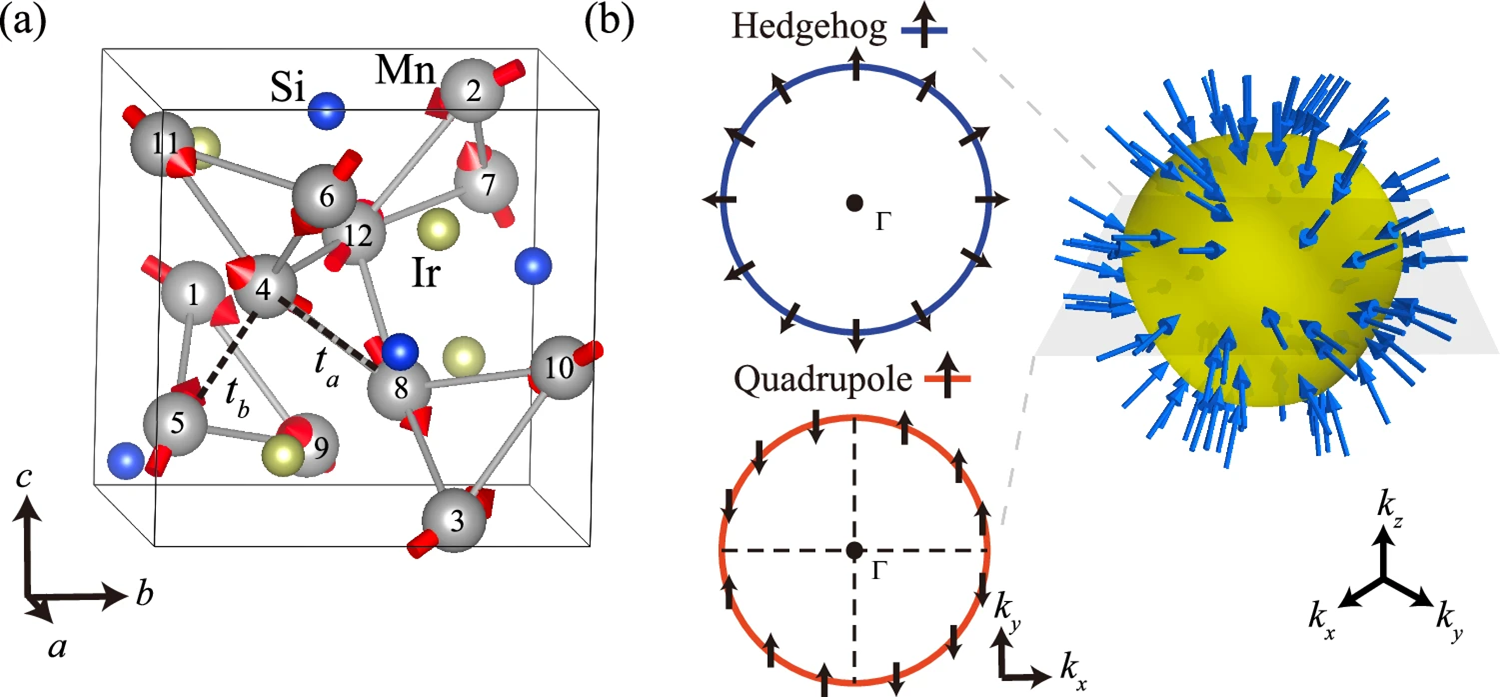
The recent study extends altermagnetism into a richer and less explored territory by combining it with two additional features: non-collinearity and chirality. In a conventional altermagnet, the magnetic moments still point along a single common axis, even if they alternate in direction. Non-collinear means the moments point in a variety of directions spread across three-dimensional space, with no single shared axis. Chirality adds a handedness to the crystal structure: the arrangement of atoms cannot be superimposed on its own mirror image, in the same way that a left hand and a right hand are related but distinct. When these features combine, the material’s internal symmetry allows for richer patterns of magnetic organization, which in turn create intricate arrangements of spin in the abstract mathematical space that describes how electrons propagate through the crystal’s periodic structure. Crucially, the lowest-order of these patterns, a dipolar spin arrangement, is directly responsible for the transport effects the researchers predict.
A primary example
The study focuses on manganese iridium silicide, Mn₃IrSi, as its primary example. This compound forms a cubic crystal structure containing twelve manganese atoms per unit cell, with their magnetic moments arranged in a compensated non-collinear pattern, meaning the moments point in varied directions but cancel out perfectly so that no net magnetization remains. Iridium is a heavy element that physicists typically associate with strong spin-orbit coupling, the relativistic interaction by which an electron’s motion through the crystal becomes linked to its spin. Strong spin-orbit coupling is ordinarily considered the essential ingredient for the spintronic effects of interest. Remarkably, detailed calculations show that despite iridium’s presence, spin-orbit coupling plays only a negligible role in shaping the electronic structure of Mn₃IrSi. The dominant force is the magnetic exchange interaction between atoms, which is orders of magnitude stronger. The non-collinear magnetic arrangement itself, arising from geometrical frustration among competing exchange interactions, is sufficient to generate the desired effects.
No spin-orbit effects. What?!
Through symmetry arguments, simplified models, and advanced computational simulations of the electronic bands, the researchers uncovered characteristic spin patterns in momentum space. These include hedgehog-like features, in which the spin associated with electrons points radially outward or inward around key points in momentum space, as well as a second, quadrupolar pattern in which the spin distribution has a more complex, four-lobed structure. Both textures emerge directly from the chiral non-collinear magnetic order, persisting even when spin-orbit effects are entirely removed from the calculations. This persistence is the key theoretical finding: the symmetry of the magnetic arrangement alone, not any relativistic effect, generates the spin texture.
These spin textures are the microscopic origin of two important transport phenomena: the spin Hall effect and the Edelstein effect. In the spin Hall effect, passing an electric current through the material causes a sideways flow of spin, with electrons carrying spin-up deflected in one direction and electrons carrying spin-down deflected in the other, producing a transverse spin current perpendicular to the applied voltage. Conventionally, this effect relies heavily on spin-orbit coupling and is strongest in bulk materials containing heavy elements such as platinum or tungsten. In the chiral non-collinear altermagnets studied here, the spin Hall effect instead arises directly from the hedgehog spin texture and is largely independent of spin-orbit coupling. The predicted magnitude is comparable to values calculated for conventional spin Hall materials, and an order of magnitude larger than those computed for lighter non-magnetic semiconductors.
The Edelstein effect is similarly striking. Here, applying an electric field generates a net spin polarization throughout the bulk of the material: spins that would otherwise cancel each other are pushed slightly out of balance, producing a measurable magnetization. In its classical form, this effect requires both spin-orbit coupling and broken inversion symmetry, conditions that are met at surfaces and interfaces between different materials, or in certain non-centrosymmetric bulk crystals. In chiral non-collinear altermagnets, the dipolar component of the magnetic order parameter drives the same outcome through a purely magnetic mechanism, again largely free of spin-orbit coupling. Both effects are therefore accessible throughout the bulk of the material rather than being confined to interfaces, which simplifies experimental detection and practical implementation.
What makes this shift significant is that the physics operates at the energy scale of magnetic exchange interactions, which are orders of magnitude stronger than spin-orbit effects. This could translate into more robust and efficient spin-charge conversion in a wider range of materials, without requiring heavy elements or the engineering of delicate interfaces. The absence of net magnetization also means such materials would be more stable in dense circuits than ferromagnetic alternatives.
A guide for finding new candidate materials
The ideas extend well beyond Mn₃IrSi. The symmetry principles that govern these effects provide a clear guide for finding new candidate materials: the key requirements are a chiral crystal structure, a non-collinear compensated magnetic order, and the absence of inversion symmetry. The authors identify several promising candidates in the same structural family, including Mn₃IrGe, Mn₃CoGe, and Mn₃RhGe, as well as compounds in other structural families such as certain manganese oxides. Symmetry analysis thus functions as a materials-design tool, narrowing the search for systems where these effects should appear.
As experiments test these predictions in Mn₃IrSi and related systems, the theoretical framework developed here will help interpret results and guide further material design. More broadly, this work illustrates how condensed matter physics often advances by recognizing that familiar concepts, magnetism, symmetry, and electron transport, can combine in unexpected ways to produce phenomena that no single ingredient alone would suggest. In an era demanding faster, greener electronics, chiral non-collinear altermagnets point toward a promising path: one where subtle magnetic symmetries unlock efficient spin manipulation, free from many conventional limitations, and invite the next wave of discovery.
Author: César Tomé López is a science writer and the editor of Mapping Ignorance
Disclaimer: Parts of this article may have been copied verbatim or almost verbatim from the referenced research paper/s.
References
- M. Hu, O. Janson, C. Felser, P. Mcclarty, J. van den Brink, and M. G. Vergniory (2025) Spin Hall and Edelstein effects in chiral non-collinear altermagnets Nat. Commun. doi: 10.1038/s41467-025-64271-8 ↩