Search results: climate change

Reduced air pollution is making clouds reflect less sunlight

Reduced air pollution is making clouds reflect less sunlight

Environment • Physics • Planetary Science

By Invited Researcher

Author: Knut von Salzen, Senior Research Scientist, Marine Cloud Brightening Research Program, University of Washington Winter is setting in across the Northern Hemisphere, and with it, cold and cloudy winter days. Clouds play a vital role in the environment, providing rain but also reflecting sunlight before it reaches the Earth’s surface. But between 2003 and […]
Dinosaur ‘mummies’

Dinosaur ‘mummies’

Geosciences

By Invited Researcher

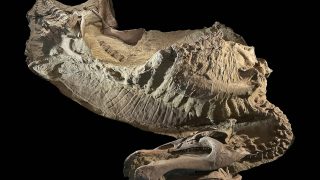
Author: Paul C. Sereno, Professor of Paleontology, University of Chicago Dinosaur “mummies” couldn’t have been further from my mind as I trudged up a grassy knoll on the Zerbst Ranch in east-central Wyoming, followed by University of Chicago undergraduates on a field trip linked to my “Dinosaur Science” course. As a university professor, I realized […]

First complete mathematical description of stalagmite shapes

First complete mathematical description of stalagmite shapes

Geosciences • Mathematics

By Mapping Ignorance

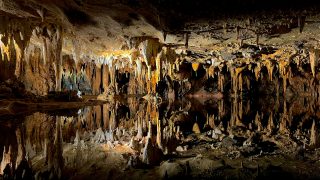
Deep inside caves, water dripping from the ceiling creates one of nature’s most iconic formations: stalagmites. These pillars of calcite, ranging from centimetres to many meters in height, rise from the cave floor as drip after drip of mineral-rich water deposits a tiny layer of stone. Beyond their beauty—echoed in fanciful nicknames like the “Minaret&#8221 […]

How pterosaurs learned to fly

How pterosaurs learned to fly

Evolution • Geosciences

By Invited Researcher

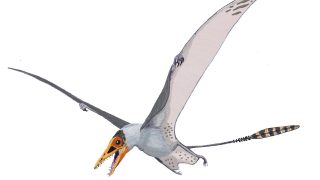
Authors: Davide Foffa, Research Fellow in Palaeobiology, University of Birmingham; Alfio Alessandro Chiarenza, Royal Society Newton International Fellow in Palaeontology, UCL, and Emma Dunne, Assistant Professor in Paleobiology, Friedrich-Alexander-Universität Erlangen-Nürnberg Ever since the first fragments of pterosaur bone surfaced nearly 250 years ago, palaeontologists have puzzled over one question: how did these close cousins of […]

On real-life Mars exploration

On real-life Mars exploration

Geosciences • Planetary Science

By Invited Researcher

Author: Ari Koeppel, Postdoctoral Scientist in Earth and Planetary Science, Dartmouth College Andy Weir’s bestselling story “The Martian” predicts that by 2035 NASA will have landed humans on Mars three times, perfected return-to-Earth flight systems and collaborated with the China National Space Administration. We are now 10 years past the Hollywood adaptation’s 2015 release and […]

150 years ago, the Metre Convention determined how we measure the world

150 years ago, the Metre Convention determined how we measure the world

History

By Invited Researcher

Author: Jonathan Simone, Adjunct Professor of Biological Sciences, Brock University On May 20, 1875, delegates from a group of 17 countries gathered in Paris to sign what may be the most overlooked yet globally influential treaty in history: the Metre Convention. At a time when different countries (and even different cities defined weights and lengths […]

MI weekly selection #597

MI weekly selection #597

Weekly Selection

By César Tomé

Asteroid samples reveal ancient salty incubators Samples from asteroids Ryugu and Bennu have revealed the presence of salts, indicating that salty water environments were common in the early solar system. This finding suggests that such environments could have been incubators for life’s building blocks, a discovery that highlights the potential for organic evolution on asteroids […]