Article archives

MI weekly selection #503

MI weekly selection #503

Weekly Selection

By César Tomé

Ancient fish that ate humans’ ancestors discovered Researchers have excavated the remains of a giant ancient bony fish species with fangs from about 350 million years ago in what is now South Africa. The findings, published in the journal PLOS One, indicate that the Hyneria udlezinye species measured up to 2.7 meters long and likely […]

Controlling the magnetic anisotropy of a transition metal complex

Controlling the magnetic anisotropy of a transition metal complex

DIPC Electronic PropertiesNanotechnology

By DIPC

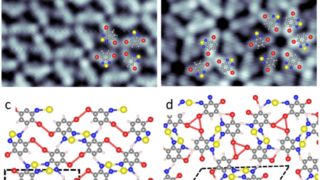
As candidates for high-density data storage and quantum computation, magnetic transition metal complexes have attracted extensive attention. It has been established that the atomic surroundings of the magnetic ions play a significant role and govern the magnetism of these magnetic complexes. One feature in particular, magnetic anisotropy, which describes the preferential orientation of the magnetic […]

Communication with Extraterrestrial Intelligent Beings: a sociolinguistic approach

Communication with Extraterrestrial Intelligent Beings: a sociolinguistic approach

LinguisticsSociology

By Invited Researcher

Author: Juan F. Trillo, PhD in Linguistics and Philosophy (U. Autónoma de Madrid), PhD in Literary Studies (U. Complutense de Madrid). This essay is an excerpt from the paper that will be presented at the IX Jornadas de Divulgación Científica at the city of Medellín, Badajoz (Spain), March 2-5, 2023. The possibility of establishing contact […]

High-speed star formation

High-speed star formation

Astrophysics

By César Tomé

Gas clouds in the Cygnus X Region, a region where stars form, are composed of a dense core of molecular hydrogen (H2) and an atomic shell. These ensembles of clouds interact with each other dynamically in order to quickly form new stars. The Cygnus X region is a vast luminous cloud of gas and dust […]

MI weekly selection #502

MI weekly selection #502

Weekly Selection

By César Tomé

Analysis of cell villages yields insight into Zika infections Studying cell villages, or samples from different donors in a shared environment, is an effective method “to identify genes and genetic variants that change a cell’s phenotype.” Scientists used the method along with the Dropulation and Census-seq algorithms to assess genetic variation in cell villages and […]

Mermin–Wagner theorem for practical length scales

Mermin–Wagner theorem for practical length scales

DIPC Advanced materialsMaterials

By DIPC

Mermin–Wagner The demand for computational power is increasing exponentially, following the amount of data generated across different devices, applications and cloud platforms. To keep up with this trend, smaller and increasingly energy-efficient devices must be developed, which require the study of compounds not yet explored in data-storage technologies. The discovery of magnetically stable 2D van […]

Losing genes can be good, hummingbirds are a nice example

Losing genes can be good, hummingbirds are a nice example

BiologyGenetics

By Invited Researcher

Author: Ramón Muñoz-Chápuli has been Professor of Animal Biology in the University of Málaga until his retirement. He has investigated for forty years in the fields of developmental biology and animal evolution. Hummingbirds are fascinating animals. They are the only birds able to true hovering and backward flight. This ability allows them to collect nectar […]

Beyond lithium: magnesium rechargeable batteries

Beyond lithium: magnesium rechargeable batteries

ChemistryMaterials

By César Tomé

Lithium-ion batteries have remained unrivalled in terms of overall performance for several applications, as evidenced by their widespread use in everything from portable electronics to cellular base stations. However, they suffer from some important disadvantages that are difficult to ignore. For one, lithium is rather expensive, and the fact that it is being mined at […]

A single gene might be responsible for the bigger brain of modern humans

A single gene might be responsible for the bigger brain of modern humans

EvolutionGeneticsNeurobiology

By Rosa García-Verdugo

We, humans, have evolved pretty big brains compared to other mammals, and even compared to our primate cousins. Recent research seems to have found the reason for the higher number of neurons in our brains (about 86 billion). It appears that a single gene is responsible for our bigger brain. The Neanderthals are an extinct […]